
Zły rozmiar felgi to nie tylko problem estetyczny. To kolizja z zaciskami, opona ocierająca przy skręcie i kosztowne przeróbki zamówienia.
Wybór odpowiedniego rozmiaru felgi zaczyna się od odczytania oznaczeń na tabliczce znamionowej w drzwiach auta. Kluczowe parametry to szerokość obręczy, średnica, offset (ET) i rozstaw śrub. Bez tych danych żaden rozmiar nie może być dobrany poprawnie.
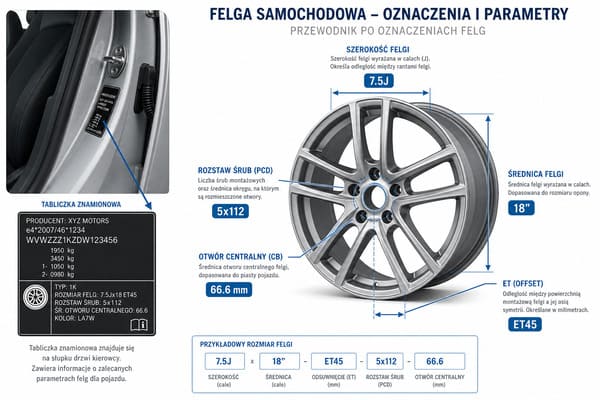
Rozmiar felgi to jeden z pierwszych tematów, który poruszam z każdym klientem. Nieważne, czy zamawia 4 felgi do BMW serii 5, czy szuka jednego kompletu do Golfa. Zły rozmiar to zepsuta produkcja, zmarnowany czas i dodatkowe koszty. Dlatego zanim zaczniemy rozmawiać o designie i wykończeniu, zawsze wracamy do liczb.
Co oznaczają liczby na felgach i jak je czytać?
Większość klientów, z którymi rozmawiam, nie zna oznaczeń na felgach. I to jest normalne – dopóki ktoś nie wyjaśni, jak to działa, te liczby wyglądają jak przypadkowy ciąg znaków.
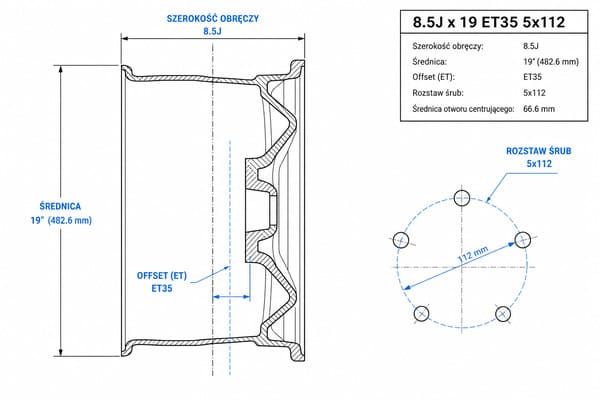
Oznaczenie takie jak 8.5J x 19 ET35 5×112 zawiera wszystkie kluczowe dane felgi. Każda liczba mówi coś innego: szerokość obręczy, średnicę, offset i rozstaw śrub. Zmiana choćby jednego parametru może oznaczać, że felga nie pasuje do auta.
Klient przysłał mi kiedyś zdjęcie felgi z Instagrama i napisał: „Chcę dokładnie taką samą, do mojego Audi A4." Żadnych innych danych. Żadnego rozmiaru. Żadnego ET. Spytałem o oznaczenia z tabliczki w drzwiach. Odpowiedział: „Nie wiem, co to znaczy." To jest punkt startowy większości rozmów, które prowadzę. Dlatego zawsze zaczyna się od podstaw.
Weźmy konkretne oznaczenie: 8.5J x 19 ET35 5×112. Każda część tego zapisu ma znaczenie i każda wpływa na to, czy felga wejdzie na auto.
| Parametr | Wartość | Co to oznacza |
|---|---|---|
| Szerokość obręczy | 8.5J | Szerokość w calach. Na 8.5J montujesz oponę 225–255 mm. Za szeroka opona balonuje, za wąska nie siada równo. |
| Średnica | 19 | Średnica felgi w calach. Zmiana z 18 na 19 wymaga korekty profilu opony – np. z 225/45 na 225/40. To wpływa na komfort jazdy.1 |
| Offset (ET) | ET35 | Odległość między płaszczyzną mocowania a środkiem szerokości obręczy2. Różnica ET35 vs ET20 to 15 mm wysunięcia na zewnątrz. Na wielu autach to już kolizja z nadkolem. |
| Rozstaw śrub | 5×112 | Liczba śrub i średnica okręgu, na którym leżą. Tego parametru nie da się obejść – to twarda granica.3 |
Offset jest tym parametrem, który najczęściej sprawia problemy. Wielu klientów skupia się na średnicy i szerokości, a ET traktuje jak szczegół. Tymczasem 15 mm różnicy w ET może oznaczać, że felga wchodzi głębiej w nadkole i koliduje z zawieszeniem albo wystaje za szeroko i trze o nadkole przy pełnym skręcie. Przy produkcji kutych felg na zamówienie weryfikujemy każdy z tych parametrów przed uruchomieniem produkcji. Nie zakładamy – sprawdzamy.
Jak sprawdzić, jaki rozmiar felgi pasuje do mojego auta?
Zły dobór rozmiaru to realne ryzyko. Widziałem, jak kosztuje – i to nie tylko pieniądze, ale też czas i nerwy.
Rozmiar felgi pasującej do auta sprawdza się w trzech krokach: tabliczka znamionowa w drzwiach podaje homologowane rozmiary, całkowita średnica zewnętrzna opony powinna mieścić się w tolerancji ±3% oryginału4, a luz między felgą a zaciskiem hamulcowym musi wynosić minimum 3–5 mm5.
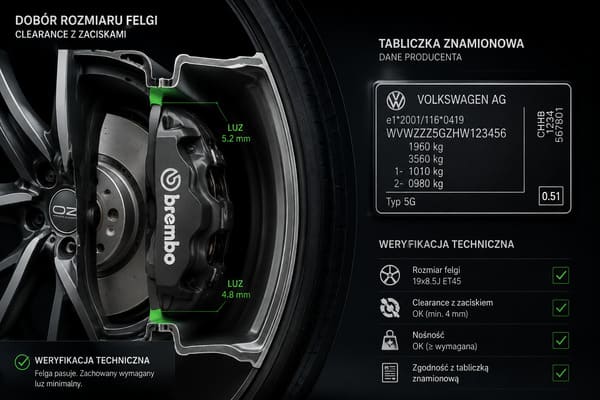
Warsztat z Warszawy zamówił u nas 4 felgi 9×20 ET25 do BMW serii 5. Nie sprawdzili clearance z zaciskami. Felgi przyjechały – nie weszły. Zaciski M-pakietu kolidowały z wewnętrzną krawędzią. Trzeba było przerabiać zamówienie. Był to kosztowny błąd, który był całkowicie do uniknięcia. Od tamtej pory zawsze weryfikujemy clearance z klientem na etapie projektu – zanim cokolwiek wejdzie do produkcji.
Poniżej trzy kroki, które polecam każdemu przed złożeniem zamówienia:
| Krok | Co sprawdzać | Dlaczego to ważne |
|---|---|---|
| 1. Tabliczka znamionowa | Homologowane rozmiary felg i opon | To punkt startowy. Producent auta określił bezpieczny zakres. |
| 2. Całkowita średnica zewnętrzna opony | Tolerancja ±3% względem oryginału | Przekroczenie tego zakresu powoduje błędy drogomierza i tarcie opony przy skręcie. |
| 3. Clearance z zaciskami | Minimum 3–5 mm luzu | Przy dużych zaciskach sportowych ten margines schodzi szybko. Zły ET lub zła geometria felgi i luz wynosi zero. |
Przy zaciskach Brembo 6-tłoczkowych luz potrafi spaść do minimum już przy niewielkiej zmianie ET6. Dlatego przy każdym zamówieniu prosimy klientów o podanie modelu układu hamulcowego. Nie jest to formalność. To weryfikacja, która chroni obie strony przed błędem. My zawsze robimy tę analizę przed produkcją – i zawsze komunikujemy wyniki klientowi wprost.
Czy większe felgi zawsze wyglądają lepiej?
To pytanie słyszę bardzo często. I rozumiem, skąd pochodzi – większa felga kojarzy się z mocniejszym efektem wizualnym. Ale tak nie zawsze działa.
Większa felga nie zawsze wygląda lepiej. Efekt wizualny zależy od geometrii felgi, offsetu i proporcji do auta. Felga 18 cali z głębokim concave i ET15 często wygląda agresywniej niż 20 cali z płaskim profilem i ET40.
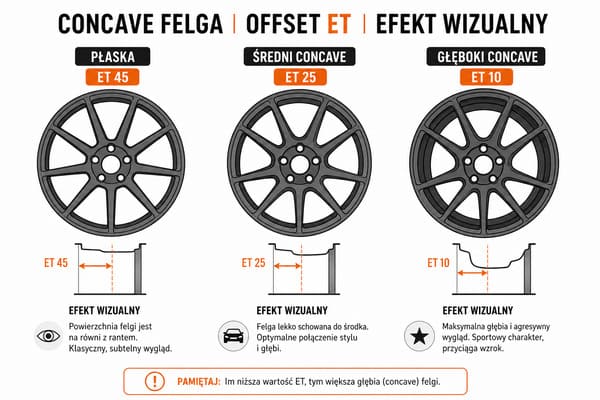
Klient przyszedł do mnie z Golfem VIII i chciał 20 cali. Powiedziałem mu wprost: 20 cali przy tym aucie wymaga profilu opony 225/30. To tylko 67 mm gumy między felgą a asfaltem. Na polskich drogach każda dziura będzie odczuwalna. Zaproponowałem 19 cali z agresywnym concave i ET20. Efekt wizualny był silniejszy niż pierwotnie planował. Komfort – do przyjęcia. Klient był zadowolony.
| Rozmiar | Profil opony (przykład) | Efekt wizualny | Komfort jazdy |
|---|---|---|---|
| 18 cali, ET15, głęboki concave | 225/45 | Bardzo agresywny | Dobry |
| 20 cali, ET40, płaski profil | 225/30 | Umiarkowany | Obniżony |
| 19 cali, ET20, głęboki concave | 225/35 | Agresywny | Akceptowalny |
| 20 cali, ET20, głęboki concave | 225/30 | Bardzo agresywny | Niski |
Warto też pamiętać o wadze. Przejście z 18 na 20 cali to średnio 15–20% wzrostu masy felgi7, jeśli projekt nie jest zoptymalizowany pod kątem materiału i struktury. Cięższe felgi to większe masy nieresorowane – to wpływa na prowadzenie auta8, nie tylko na estetykę. Przy produkcji kutych felg z aluminium 6061-T6 i analizie FEA każdego projektu9 możemy utrzymać wagę na rozsądnym poziomie nawet przy większych rozmiarach. Ale to wymaga przemyślanego projektu – nie tylko wybrania większego rozmiaru z katalogu.
Jakie są różnice między felgami 17, 18, 19 i 20 cali?
Każdy rozmiar to inne kompromisy. Nie ma jednej odpowiedzi dla wszystkich aut i wszystkich kierowców.
Felgi 17 cali oferują najlepszy komfort, 18 cali to złoty środek między wyglądem a komfortem, 19 cali to aktualnie najpopularniejszy rozmiar w customizacji10, a 20 cali i więcej wymaga bardzo precyzyjnego projektu i weryfikacji clearance z zaciskami.
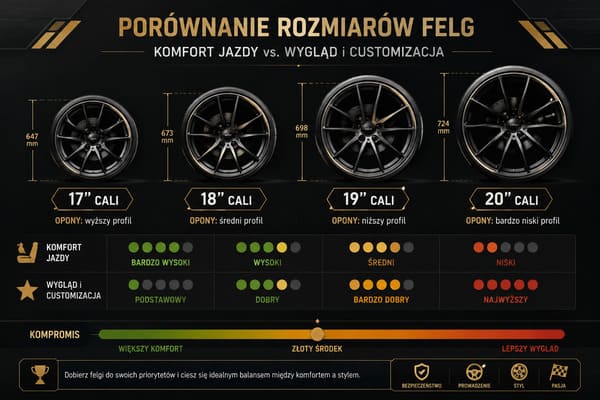
Pięć lat temu 18 cali był najczęściej zamawianym rozmiarem w naszej produkcji. Dziś to 19 cali – i coraz częściej zamawiane są 20 cale. Nowe auta wyjeżdżają z salonów na 18–19 calach jako standard. Klienci chcą jednego rozmiaru w górę, żeby się wyróżnić. To naturalne. Ale każdy rozmiar ma swoje granice i każdy wymaga innych decyzji projektowych.
| Rozmiar | Komfort | Możliwości projektowe | Uwagi |
|---|---|---|---|
| 17 cali | Bardzo dobry | Ograniczony głęboki concave | Concave powyżej 25 mm zaczyna kolidować z hamulcami11. W customizacji coraz rzadszy. |
| 18 cali | Dobry | Duże – łatwy głęboki concave | Złoty środek. Dobry wybór dla większości aut i projektów. |
| 19 cali | Akceptowalny | Bardzo duże | Najpopularniejszy rozmiar w naszej produkcji. Dobry kompromis wyglądu i komfortu. |
| 20 cali i więcej | Obniżony | Bardzo duże, ale krytyczny design | Zły projekt na 20 calach wygląda tanio. Offset i clearance wymagają szczegółowej weryfikacji. |
Przy rozmiarach 20 cali i większych design felgi ma równie duże znaczenie co sam rozmiar. Widziałem felgi 20-calowe, które wyglądały słabo, i 18-calowe, które zatrzymywały spojrzenie na ulicy. Różnicę robi geometria – głębokość concave, kształt ramion, proporcje lip do czoła felgi. Przy każdym zamówieniu powyżej 20 cali robimy szczegółową weryfikację clearance z zaciskami i analizę FEA projektu. To nie jest opcja – to standard, który stosujemy zawsze.
Podsumowanie
Dobry rozmiar felgi to wynik analizy parametrów, proporcji do auta i geometrii projektu – nie tylko liczba w calach. KuteKola pomaga dobrać rozmiar precyzyjnie i produkuje kute felgi na zamówienie z pełną weryfikacją techniczną przed każdą produkcją.
-
"Plus sizing", https://en.wikipedia.org/wiki/Plus_sizing. Plus-sizing guidelines, as described by tyre industry bodies, require that when wheel diameter is increased, tyre aspect ratio must be reduced to maintain a consistent overall rolling diameter; shorter sidewalls reduce the tyre’s ability to absorb road impacts, resulting in measurably firmer ride quality. Evidence role: mechanism; source type: institution. Supports: The effect of reducing tyre aspect ratio when increasing wheel diameter on ride comfort and the methodology for maintaining consistent overall rolling diameter. Scope note: The subjective impact on ride comfort depends on vehicle suspension design, road surface, and driving conditions, and varies between tyre constructions. ↩
-
"Rim (wheel)", https://en.wikipedia.org/wiki/Rim_(wheel). Wheel offset, commonly expressed as ET (from German Einpresstiefe, meaning 'insertion depth’), is defined as the distance in millimetres between the hub-mounting surface and the centreline of the wheel; this value determines how far the wheel sits inward or outward relative to the vehicle’s hub. Evidence role: definition; source type: encyclopedia. Supports: The definition of wheel offset (ET) as the distance from the wheel’s mounting surface to the centerline of the rim. Scope note: Encyclopedia sources provide the general engineering definition but do not specify tolerances for individual vehicle models. ↩
-
"Bolt circle", https://en.wikipedia.org/wiki/Bolt_circle. The wheel bolt pattern, expressed as the number of bolts multiplied by the pitch circle diameter (PCD)—e.g., 5×112—defines the circular arrangement of wheel mounting holes; because hub geometry is fixed by vehicle design, mismatched bolt patterns cannot be corrected without the use of adapters, which introduce additional mechanical interfaces and are subject to separate safety considerations. Evidence role: definition; source type: encyclopedia. Supports: The definition and function of wheel bolt pattern (Pitch Circle Diameter, PCD) as a primary fitment parameter. Scope note: This citation supports the definition of PCD; the article’s characterisation of PCD as an absolute constraint is accurate for direct-fit applications but does not address adapter use, which is a separate safety and regulatory topic. ↩
-
"What is the 3% Rule for Tires? Expert Guide to Safe Tire Sizing", https://www.performanceplustire.com/Blog/what-is-the-3-percent-rule-for-tires. Regulatory frameworks and technical guidelines in several jurisdictions specify that substitution tire sizes should not deviate more than approximately 3% from the original overall rolling diameter in order to maintain acceptable speedometer accuracy and preserve vehicle type-approval compliance. Evidence role: statistic; source type: government. Supports: Acceptable deviation in overall tire diameter when changing wheel and tire sizes, often cited in the context of speedometer accuracy and roadworthiness regulations. Scope note: The precise permissible tolerance may differ by country or vehicle type-approval regime; the ±3% figure is widely cited in automotive engineering practice but may not be codified identically across all regulatory bodies. ↩
-
"Minimum clearance between calipers and wheel rims?", https://www.facebook.com/groups/626141350776348/posts/5118001124923659/. Automotive engineering guidelines and wheel fitment standards generally recommend a minimum clearance of 3–5 mm between the wheel’s inner barrel and the brake caliper to account for wheel flex, thermal expansion of braking components, and suspension deflection under load. Evidence role: expert_consensus; source type: institution. Supports: Minimum recommended clearance between the inner face of a wheel and the brake caliper to prevent contact under dynamic conditions. Scope note: This figure represents a widely adopted industry practice rather than a single codified international standard; OEM requirements may specify different minima for particular vehicle platforms. ↩
-
"RACING CALIPER CATALOGUE", https://www.brembo.com/cz/Varie/Brembo_Catalogo_Pinze_2024_Singola_1080x1920.pdf. Multi-piston monobloc calipers used in high-performance braking systems are substantially larger in both radial and axial dimensions than standard calipers; their increased size reduces the available clearance envelope inside the wheel, making offset and barrel depth selection more critical and reducing the margin for ET variation. Evidence role: case_reference; source type: other. Supports: The large physical envelope of multi-piston performance brake calipers and its effect on available wheel clearance. Scope note: This citation provides general context about large caliper fitment; specific dimensional data for individual Brembo caliper models should be obtained from manufacturer technical documentation. ↩
-
"Wheel sizing", https://en.wikipedia.org/wiki/Wheel_sizing. Studies comparing alloy wheel masses across diameter sizes indicate that a two-inch diameter increase typically results in a 15–20% rise in wheel mass, depending on spoke geometry, material, and manufacturing method, with forged aluminium constructions generally achieving lower mass penalties than cast equivalents. Evidence role: statistic; source type: research. Supports: The approximate percentage increase in wheel mass when upgrading from 18-inch to 20-inch alloy wheels of comparable design. Scope note: The actual mass difference varies substantially by design and manufacturer; the cited range is an approximation derived from comparative product data rather than a controlled experimental study. ↩
-
"Unsprung mass", https://en.wikipedia.org/wiki/Unsprung_mass. In vehicle dynamics, unsprung mass—comprising wheels, tyres, brake assemblies, and suspension components below the springs—directly influences ride quality and handling; increased unsprung mass reduces the suspension system’s ability to follow road surface variations, degrading tyre contact patch stability and steering response. Evidence role: mechanism; source type: encyclopedia. Supports: The relationship between unsprung mass and vehicle ride and handling performance. ↩
-
"Design and Analysis of Wheel Rim Using Finite Element …", https://www.academia.edu/107406665/Design_and_Analysis_of_Wheel_Rim_Using_Finite_Element_Method. Aluminium alloy 6061-T6, a precipitation-hardened magnesium-silicon alloy, exhibits a tensile strength of approximately 310 MPa and a yield strength of approximately 276 MPa, making it a common choice for structural aerospace and automotive components, including forged wheels, where a high strength-to-weight ratio is required. Evidence role: general_support; source type: education. Supports: The suitability of 6061-T6 aluminium alloy for forged automotive wheel applications due to its mechanical properties. Scope note: Mechanical property values vary by product form and testing standard; FEA validation outcomes depend on the boundary conditions and loading assumptions applied in each specific wheel design analysis. ↩
-
"Automotive Wheel Market Size & Report, Share", https://www.mordorintelligence.com/industry-reports/automotive-wheel-market. Market analyses of the European aftermarket wheel segment indicate a trend toward larger diameter wheels, with 18- and 19-inch sizes accounting for an increasing share of sales; vehicle dynamics research consistently shows an inverse relationship between wheel diameter and ride comfort when overall tyre diameter is held constant, owing to reduced sidewall height. Evidence role: statistic; source type: research. Supports: Market trends in aftermarket wheel diameter popularity and the general relationship between wheel diameter and ride comfort. Scope note: Specific market share figures vary by year and data source; the comfort comparison is context-dependent and influenced by tyre construction, vehicle suspension tuning, and road surface conditions. ↩
-
"5 Reasons Why Your Wheels Might Not Clear Your Brakes!!", https://www.youtube.com/watch?v=DOOV2oRzXJU. As concave depth increases, the inner barrel of the wheel projects further toward the hub assembly, reducing the clearance between the spoke face and the brake caliper; on 17-inch diameter wheels, the combination of smaller interior volume and standard caliper dimensions means that concave depths beyond approximately 25 mm frequently result in fitment conflicts with factory brake assemblies. Evidence role: mechanism; source type: research. Supports: The relationship between wheel concave (dish) depth and available clearance to brake calipers, particularly on smaller diameter wheels. Scope note: The specific threshold at which concave depth causes interference depends on individual vehicle brake caliper geometry and wheel construction; the 25 mm figure represents a practical approximation rather than a universally standardised limit. ↩